House Washing
Why Soft Wash House Washing Beats DIY Pressure Cleaning in Auckland
The risks of high-pressure DIY cleaning, and why professional soft washing is the smarter choice for your home.
By Hydro Clean NZ Limited · July 2026 · 5 min read
If you’ve ever looked at the green, slimy streaks creeping up your weatherboards and thought about hiring a pressure washer from Bunnings for the weekend—stop. That DIY pressure cleaner can do serious damage to your home’s exterior, and the cost of fixing that damage far outweighs what you’d save on a professional wash. Here’s why soft wash house washing has become the gold standard for Auckland homes, and why it’s almost always the better choice.
The Auckland Climate Problem
Auckland’s humidity is the perfect breeding ground for mould, algae and black lichen. Our summers are warm and damp, our winters are wet, and many homes sit in valleys or under tree cover where shade keeps surfaces perpetually moist. If you live near the coast, salt air adds another layer of grime that bonds to cladding over time.
The result? Within 12 to 18 months, most Auckland exteriors start looking tired. Dark patches appear on south-facing walls, lichen spots embed themselves into paint, and the whole house loses that fresh, clean look it had after the last paint job.
Why High-Pressure Washing Makes Things Worse
A petrol pressure washer from the hire shop might push out 3,000–4,000 PSI. That’s more than enough to strip paint off weatherboards, force water behind cladding into your wall cavity, blast mortar out of brick joints, and gouge soft timbers. We’ve seen homes where a well-meaning DIY attempt has:
- Blasted chunks out of plaster and roughcast cladding
- Forced water behind flashing, causing internal wall leaks
- Stripped the UV-protective topcoat off painted weatherboards
- Etched lines into wooden joinery that then absorbed moisture and rotted
- Destroyed the surface of acoustic insulation panels on garage doors
Even worse, pressure cleaning doesn’t actually kill the mould and algae—it just blasts off the visible top layer. The root structure remains embedded in the surface, and within weeks the green growth is back, often thicker than before because the surface is now rougher and easier for spores to grab onto.
How Soft Washing Works
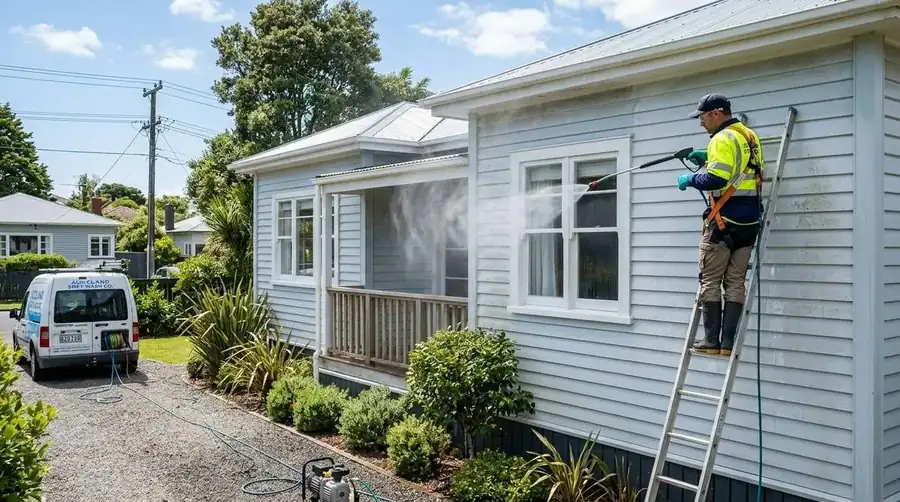
Soft washing flips the approach entirely. Instead of relying on brute-force pressure to blast away contamination, it uses a carefully formulated, biodegradable detergent applied at low pressure—typically under 500 PSI, similar to a garden hose with a spray nozzle.
The detergent is designed to break down organic growth at the root. It’s applied to the surface, left to dwell for 10–20 minutes (depending on the contamination level and cladding type), and then rinsed off with a gentle low-pressure spray. The mould, algae and lichen are killed and lifted away—not just scraped off the surface.
This method means:
- No damage to paint, cladding or joinery — the pressure is too low to erode anything
- Longer-lasting results — the root structure is killed, so regrowth takes months longer
- Better coverage — the detergent reaches into crevices and textures that pressure washing misses
- Safer for gardens and pets — modern soft-wash detergents are biodegradable and plant-safe once rinsed
When Pressure Washing IS the Right Tool
To be clear, pressure washing isn’t inherently bad—it’s the wrong tool for the wrong surface. High-pressure cleaning is excellent for hard, porous surfaces like concrete driveways, brick walls and pavers. That’s why professional exterior cleaners carry both: a soft-wash setup for cladding and painted surfaces, and a high-pressure unit for hard surfaces. If you also need your driveway water blasted, a professional crew can do both in the same visit with the right method for each surface.
Why Professional Beats DIY
Beyond the method itself, there are practical reasons to leave house washing to the professionals:
- Height and access — most two-storey Auckland homes require working at heights that are dangerous without proper equipment and training
- Chemical handling — even biodegradable detergents need correct dilution ratios and dwell times to work effectively without risk
- Surface knowledge — different claddings (weatherboard, brick, plaster, roughcast, vinyl, Linea) need different approaches, and a pro identifies and adjusts on the spot
- Time and equipment — a professional crew with commercial-grade equipment finishes in 2–4 hours what takes a DIYer an entire weekend
- Insurance — if something goes wrong on a professional job, it’s covered. If you blast a hole in your own wall, that’s on you
How Often Should You Wash?
For most Auckland homes, a soft wash every 12–18 months keeps exteriors looking sharp and prevents long-term build-up that can permanently stain or degrade cladding. If you’re in a heavily shaded spot, near bush or under mature trees, you may want to wash annually. Coastal properties benefit from more frequent cleaning to keep salt residue under control.
Pairing your house wash with a gutter clean at the same time is smart—the crew is already on site with ladders and equipment, and clear gutters complement a clean exterior perfectly.
The Bottom Line
DIY pressure cleaning might seem like a money-saver, but the risk of damage and the short-lived results make it a false economy. Professional soft washing costs less than you might expect, delivers results that last two to three times longer, and protects your home’s biggest asset—its exterior.
If your home is looking green, grey and tired, get a free quote from Hydro Clean. We’ll assess your cladding type, confirm the right approach, and give you upfront pricing before any work starts.
FAQs
Common Questions
You can buy soft-wash detergent kits for DIY use, but the results depend heavily on getting the dilution ratio, dwell time and rinse pressure right. For single-storey homes with light contamination, a careful DIY approach can work. For anything taller, heavily soiled, or with delicate cladding, a professional service is safer and more effective.
Soft washing kills the mould, algae and lichen at the root and removes the visible growth. Some deeply embedded staining on older surfaces may not fully disappear on the first clean, but a second treatment or a slightly longer dwell time usually resolves it. Most homes see a dramatic, visible difference immediately.
The biodegradable detergents we use are plant-safe once rinsed and diluted. We pre-water garden beds before application and rinse plants afterwards as a precaution. For edible gardens, we can adjust the formulation or mask off specific areas on request.
Because the detergent kills the root structure of organic growth, soft wash results typically last 18–24 months before reg becomes visible—significantly longer than pressure washing alone, which sees regrowth within weeks.
Explore Our Other Services
Ready to Book Your House Washing?
Get a free, no-obligation quote from Hydro Clean — we’ll come back to you fast with fair, upfront pricing.